

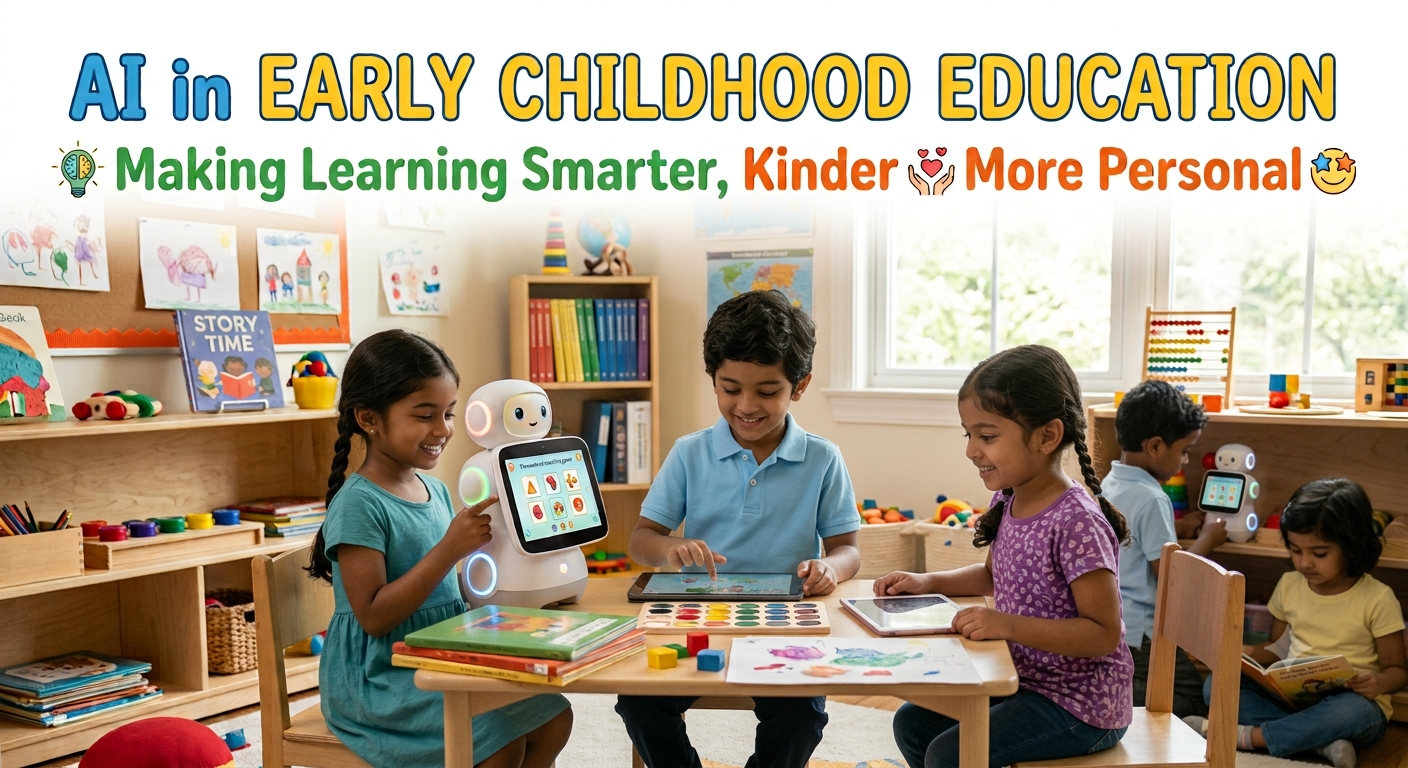
26 Aug AI in Early Childhood Education: Making Learning Smarter, Kinder & More Personal
At The Clay House, we believe that the early years should be filled with curiosity, creativity, play and discovery. Every child learns differently, and Artificial Intelligence (AI) can help us understand those differences and make learning more meaningful. AI is not about replacing teachers or putting children behind screens. It is about helping teachers understand children better, personalise learning, identify areas where support may be needed, and create more engaging learning experiences.
Why Does AI Matter in Early Childhood?
Personalised Learning for Every Child
Every child has a unique pace, interest and way of learning. AI can help educators identify these patterns even before or at the beginning of an academic year, allowing learning experiences to be better tailored to individual needs. For example: If a child loves animals but finds letter recognition difficult, teachers can introduce phonics through animal names, sounds, stories and picture games. The child learns through something they already love, without pressure, but with purpose.
Early Detection, Timely Support
AI-supported tools can help educators notice early patterns related to language development, communication, fine-motor skills and hand-eye coordination. Tools such as LENA (Language Environment Analysis) can analyse aspects of children’s language environments and vocal interactions, helping professionals identify patterns that may need closer attention. Technology-assisted observations can also help teachers notice difficulties with activities such as tracing, drawing, gripping, cutting or coordination. For instance, if a child consistently struggles with pencil activities, teachers can introduce clay modelling, threading, tearing and pasting or finger painting to strengthen fine-motor skills. AI helps us notice. Teachers understand. Specialists guide.
How AI Makes Learning More Engaging
Learning Through Play
AI can transform practice into playful exploration through digital puzzles, interactive storytelling and mini-missions. Imagine telling children, “Today, we are going on a jungle adventure!” They can explore animals, sounds, colours, vocabulary and counting through a combination of stories, movement, music, props and carefully selected digital experiences. The aim is not more screen time, it is more meaningful learning.
Empowering Teachers
AI can support teachers by organising observations, tracking progress, identifying learning patterns and suggesting differentiated activities. For example, if data shows that a child participates confidently during storytelling but hesitates during group conversations, the teacher can plan small-group activities to encourage communication. Technology provides information; teachers provide understanding, encouragement and emotional connection.
Connecting School & Home
AI-supported platforms can give parents meaningful insights into what their child is practising, enjoying and developing. Instead of simply saying, “Your child practised numbers today,” parents could receive an insight such as: “Your child confidently counted objects up to 10 and enjoyed sorting activities. Try counting toys, spoons or steps together at home.” This creates a stronger bridge between classroom learning and home experiences.
AI for Inclusion & Accessibility
Every child deserves an opportunity to participate and succeed. AI-supported tools can assist English-language learners, early-stage communicators and children with diverse learning needs through visual prompts, speech support, personalised repetition and interactive resources. At The Clay House, AI can also complement our CRISP approach, Competitions, Enrichment Activities and Life Skills, giving children additional ways to explore, express ideas and learn beyond conventional classroom experiences.
Smart Technology, Safe Childhood
At The Clay House, safety comes first.Data Privacy: Children’s information must be protected and handled responsibly.
Balanced Screen Time: Digital learning complements, not replaces, outdoor play, sensory experiences, art, movement, conversation and hands-on exploration.
Teacher-Led Use: AI supports professional judgement; it does not replace educators.
Human Connection: No technology can replace a teacher’s smile, encouragement, conversation, comforting presence or the joy of discovering something together.
What Does the Future Hold?
The future of AI in early childhood education is about smarter personalisation and richer experiences.Emotional & Adaptive AI
Future AI may become better at responding to a child’s learning pace and emotional cues. If a child is struggling, learning could slow down and provide gentle support; if a child is ready for more, it could introduce an appropriate challenge. Right support. Right moment. Right pace.
AI + AR + VR
Imagine children virtually walking through a rainforest, diving into the ocean or building a rocket ship while asking questions and following their interests. AI, Augmented Reality (AR) and Virtual Reality (VR) can take learning beyond books, but always alongside hands-on, real-world experiences.Teachers + AI
The future is not AI versus teachers. It is AI with teachers. AI can help educators understand learning patterns, track progress, suggest teaching strategies and support the review of an Individual Support Programme (ISP) for children who need additional assistance. But teachers remain at the heart of the process because they understand the child, not just the data.
At The Clay House, AI Has a Purpose We see AI as a creative partner, not a replacement for childhood. We want our children to run, touch, build, paint, sing, talk, question, imagine, make mistakes and try again. When technology can make that journey more personalised, inclusive, engaging and insightful, we embrace it thoughtfully. Because a future-ready child is not simply a child who knows technology.
At The Clay House, we bring together the best of technology, thoughtful teaching and the magic of childhood, creating classrooms where every child can explore, grow and shine.
Because when learning feels like discovery, every classroom becomes a place where magic happens.
No Comments